February 24, 2026
Baltimore City continues to refine its permitting process through updated digital systems and workflow improvements.
For commercial real estate professionals, landlords, tenants, and business owners, these changes directly impact lease negotiations, lender coordination, contractor mobilization, and tenant opening dates.
While no permitting environment is instantaneous, Baltimore City’s modernization efforts are increasing transparency, improving intake efficiency, and creating clearer pathways for certain permit types. Understanding how the system works today is critical to setting realistic schedules and avoiding preventable delays.
So how long will it take?
The more moving parts a project has, the longer it can take. Other factors, such as staffing and workload, also play a role. In the City, intake of the application can take up to 30 business days. From there, subsequent reviews can take 20 to 45 days (about 1.5 months) and require consistent follow-up with reviewers. As such, permitting should not be viewed as a back-end task. It is a front-end schedule driver that affects lease execution, contractor mobilization, and tenant occupancy dates.
Proactive communication makes a difference. Understanding evolving review procedures, clarifying timelines before submission, and building direct relationships with City reviewers to reduce uncertainty for commercial projects are among the ways Arium stays on top of the permitting process.
Strategic Takeaways for CRE Professionals
- Digital submission has improved visibility, but coordination still drives speed.
- Early code analysis reduces redesign during review.
- Proper permit classification prevents intake resets.
- Integrated architecture & engineering coordination shortens comment cycles.
As Arium AE’s Permitting Manager shares, “Permitting is about more than paperwork; it’s about relationships. By staying in close communication with Baltimore City reviewers, we stay informed on timelines and procedures, and code changes, helping our clients move forward smoothly.”
If you’re planning a tenant fit-out, building upgrade, or phased commercial construction in Baltimore City, Arium AE combines integrated AE services with hands-on permitting coordination to help you move forward with clarity and confidence.
Have a question about your permit? We are here to help. Give us a call at 410.730.2300 or contact us here. Or if you are looking for more details, keep reading below.
A Deeper Dive – Baltimore City’s New Systems & Process
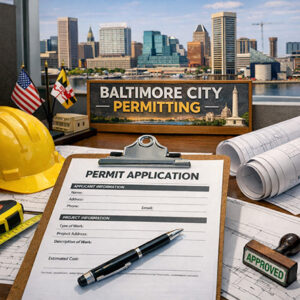 New System. Baltimore City processes commercial permits through its E-Permits Portal (Accela platform), which allows applicants to submit, pay for, and track permits online. The new system centralizes intake and routes applications to the appropriate reviewing agencies.
For commercial projects requiring drawing review, the City utilizes an electronic plans review system commonly referred to as ProjectDox or ePlans. This allows design teams to upload drawings digitally, receive reviewer comments, and resubmit revisions within the same platform.
A single permit. From the start of the permit application, all disciplines (MEP, Structural, FPE, etc.), including the general contractor, must be included in the scope and fully documented. In addition, GCs and trade professionals must be registered with the City and have an account in the E-permits portal; otherwise, this can cause significant delays.
Scope changes. Scope changes are allowed before a permit is submitted, but not after. If the scope changes after a permit is issued, a new permit for that work must be submitted. This could hold up inspections or even occupancy permit approval. However, amendments made before a permit is issued are allowed and incur no fees, but may take time.
For CRE teams managing multiple properties or phased renovations, Arium’s ability to track the project’s status under a single permit, digitally, is a significant operational improvement.
How Commercial Plan Review Works
For most commercial projects, such as tenant improvements, lobby renovations, amenity upgrades, core building improvements, equipment installations, or change-of-use conversions, the process generally follows these steps:
1. Application + Intake
The permit is submitted through the City’s E-Permits Portal and routed for completeness review. Incorrect permit type selection or incomplete documentation can cause early delays.
2. Electronic Plan Review
Drawings are uploaded for review by applicable disciplines, which may include:
- Building / structural
- Zoning
- Fire prevention
- Mechanical, electrical, plumbing (MEP)
- Accessibility compliance
The number of reviewers required directly affects the overall timeline.
3. Review Comments + Resubmittals
Most commercial permits involve at least one comment cycle. The total approval time often depends more on the number of review rounds than on the duration of the first review. Well-coordinated drawings, clear code narratives, and aligned MEP systems significantly reduce resubmittal time.
4. Issuance + Inspections
After approval and fee payment, the permit is issued. Field inspections remain critical to final approval and certificate processes.
What Impacts Commercial Approval Timelines
While the City’s digital improvements are helping stabilize intake and improve transparency, commercial permit duration is still influenced by:
- Scope complexity (structural, change of use, occupancy load impacts)
- Life-safety triggers (egress, fire protection, accessibility)
- MEP system modifications
- Completeness of submission
- Responsiveness during comment cycles
For example, a cosmetic office refresh may proceed efficiently. At the same time, a mission-critical equipment installation or a full-floor tenant build-out requiring a life-safety review will naturally require additional coordination.
Understanding Recent Baltimore City Code Updates
Baltimore City recently adopted the 2021 editions of the International Building, Fire, Mechanical, Plumbing, and Energy Conservation Codes, with the updates becoming effective in May 2024. As a result, the code adoption affects commercial projects differently depending on scope and building conditions. For interior tenant improvements in existing office or retail spaces with no change of use, structural work, or major system upgrades, the impact is typically limited to updated accessibility, energy, and life-safety coordination requirements. However, projects that involve a change of occupancy, increased occupant load, reconfigured egress paths, or significant MEP modifications may trigger a more comprehensive compliance review under the updated IBC, IFC, and IECC standards, often requiring more detailed code narratives and coordination between the architectural and engineering disciplines.
For larger shell renovations, core-and-shell repositioning, or building-wide system upgrades, the implications are more substantial. Updated energy performance thresholds, fire protection requirements, and structural provisions may affect façade modifications, vertical transportation upgrades, fire alarm and sprinkler systems, and emergency power coordination. These projects often require more comprehensive documentation up front to avoid multiple review cycles.
In practical terms, smaller commercial projects may see minimal schedule impact when properly documented. At the same time, larger or more complex scopes benefit significantly from early integrated design coordination to align with the updated 2021 code framework and reduce resubmittals during plan review.
Understanding the system and how the permitting process has evolved enables Arium’s design teams to properly document the project for expedited review. Contact Arium at 410.730.2300 or via our contact form to discuss the permitting process for your next project.