Oct 1, 2026
Part 1: Inside the opening of the University of Maryland Discovery Center and the design challenge of adapting an existing building for quantum research.
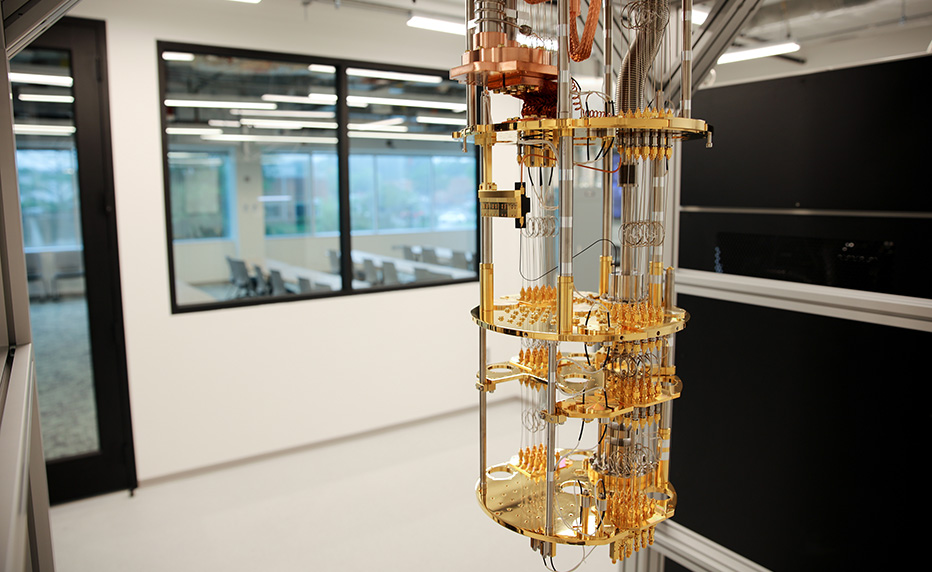
Pictured: Dilution Refrigerator – photo courtesy of Microsoft
At the September 22 opening of the University of Maryland Discovery Center, a dilution refrigerator offered guests a glimpse of the extraordinary research taking shape inside. Often called a “chandelier” for its stacked gold tiers, the equipment cools a quantum processor to a fraction of a degree above absolute zero. For Arium AE Principal Brian Frels, who attended with project manager Kelly Ormsby, it made visible the challenge behind the milestone: fitting an environment for highly sensitive quantum research into an existing building.
Governor Wes Moore spoke at the ribbon cutting in College Park, which opened a week of quantum events surrounding the September 23–25 Quantum World Congress. Arium served as prime architect and MEP engineer for Microsoft’s new quantum research center inside the Discovery Center. Our team is also serving in those roles for Quantum Motion’s research center, now under construction in the same building. The work began in summer 2025, when Arium’s survey, test fit, and pricing exercise for Terrapin Development, UMD’s development partner, proved the project was viable.
The opening gives physical form to Maryland’s Capital of Quantum initiative. Microsoft describes its center as a roughly 15,000-square-foot hub for research, partner collaboration, future prototypes, and hands-on quantum hardware training. The company will provide Majorana 2-based topological qubits for independent testing and evaluation by the Defense Advanced Research Projects Agency (DARPA).
From commitment to opening in one year
Microsoft announced its commitment to build the center at the 2025 Quantum World Congress. Arium’s viability study was key to that announcement. Design was completed in April 2026, and on-site construction followed soon afterward. One year after the announcement, leaders gathered to open the center as the Congress returned to College Park.
None of this was built from scratch. That timeline did not begin with an empty site or a purpose-built laboratory. Microsoft’s and Quantum Motion’s centers are within an existing building, a former Raytheon facility at 5700 Rivertech. Reusing a structure can accelerate research space delivery, but the design team must first establish what the building can support: the structural systems capacity, routes for shafts and services, and available utilities. Those findings shape where equipment can go and which constraints require a creative engineered solution.
The schedule demanded rapid decisions across architecture, engineering, equipment, and construction. Arium worked with UMD and tenant consultants to coordinate the research facilities’ program requirements and MEP infrastructure. “Architecture and MEP had to be solved together from the first site walk,” said Frels. Arium’s in-house team developed the spaces and systems in parallel as the requirements came into focus.
What the research asks of a building
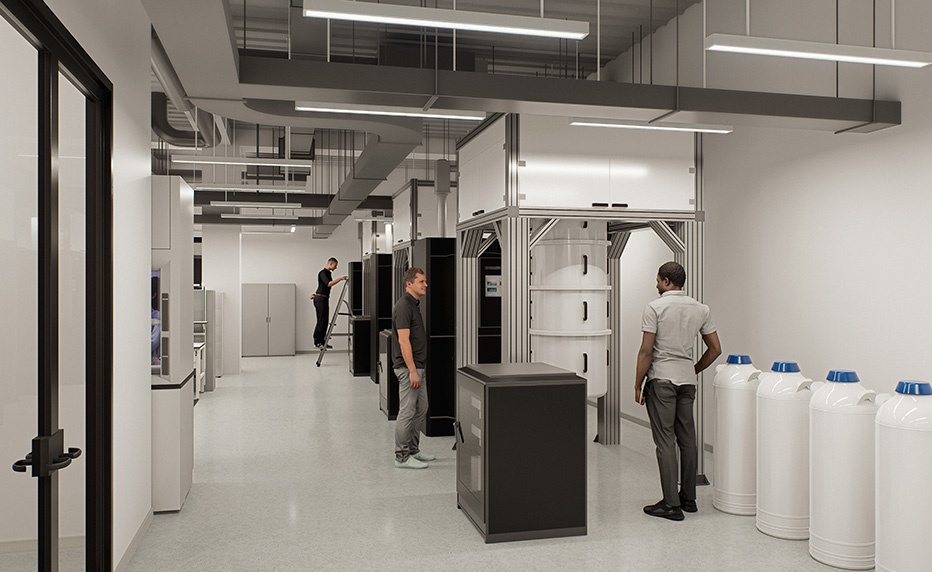
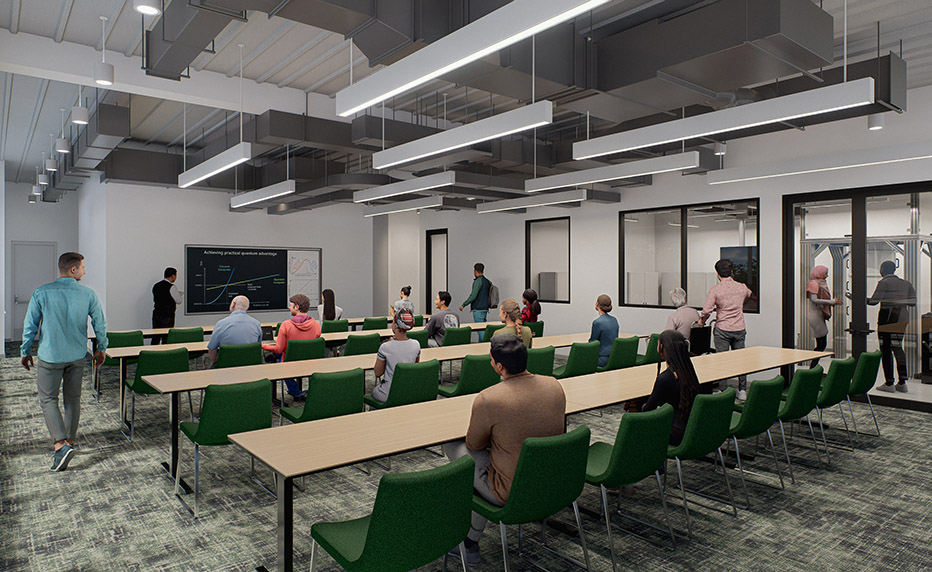
Arium’s project scope included a 15,000-square-foot fit-out across two floors, with working and teaching laboratories, offices, and a multipurpose room where students and outside partners can learn about quantum computing. Two rooftop structures house process equipment for infrastructure planned to support four initial and seven future quantum computing machines. In the offices, natural textures and colors temper the clean aesthetic of the labs while acknowledging the technical work taking place nearby.
Quantum research puts unusual demands on an ordinary building. Sensitive instruments make vibration and electromagnetic interference important design considerations; computing equipment also needs dependable power, cooling, and support for cryogenic systems. With separate research organizations sharing the same building, the team also had to address how to divide spaces and infrastructure between tenants. The specific solutions were tailored to each tenant’s equipment and security requirements, working with its specialists.
The delivery timelines and project budgets during design and construction were continuously monitored. This allowed Arium’s design team to make adjustments when requested equipment had a longer lead time than expected. For example, the originally requested and specified manufacturer of the rooftop process equipment could not meet the project’s delivery timeline. Davis Construction suggested an alternate manufacturer. Arium’s in-house mechanical engineer and Spyder Engineering, the structural engineer, adjusted their designs to accommodate the new equipment. This included participating in calls with the Microsoft team, the construction team, and the manufacturer to quickly finalize the package design and sequences, cutting weeks of back-and-forth review and months of equipment delays from the build-out.
Microsoft’s center also includes a quantum hardware makerspace intended to bring industry, academia, and government together for hands-on training on its second floor. Its broader UMD partnership includes a research workshop series and funded postdoctoral positions. The September opening is a major facility milestone; Microsoft’s team has indicated that additional hardware assembly and student activity are still to come.
Two quantum leaders. Two technologies. One design team.
Quantum Motion is developing quantum computing hardware using silicon chip manufacturing methods. Its announced move to the Discovery District brings a different technology and research program into the same building as Microsoft. Arium’s role on both centers lets our team apply its experience with adaptive reuse, advanced laboratories, and secure facilities while responding to each tenant’s distinct needs.
The two projects show how a regional research strategy becomes a series of real places. They also illustrate why the condition and capacity of an existing building matter so much to a fast-moving research program. Decisions about space, infrastructure, and specialized equipment cannot wait for one discipline to finish its work before another begins.
The ribbon cutting gave the public a first look at the Discovery Center and the momentum behind Maryland’s quantum community. We are proud to have helped bring Microsoft’s space to this milestone and to continue work on Quantum Motion’s center. When professional photography and further project details are available, the next installment will take readers closer to the design and engineering decisions behind the finished spaces.
Evaluating an existing building for lab or research use? Contact Arium AE by email or call 410-730-2300 to talk to our team.
Read more about this project: Link.